
-
 Up to 19% offVendor:Hartmann
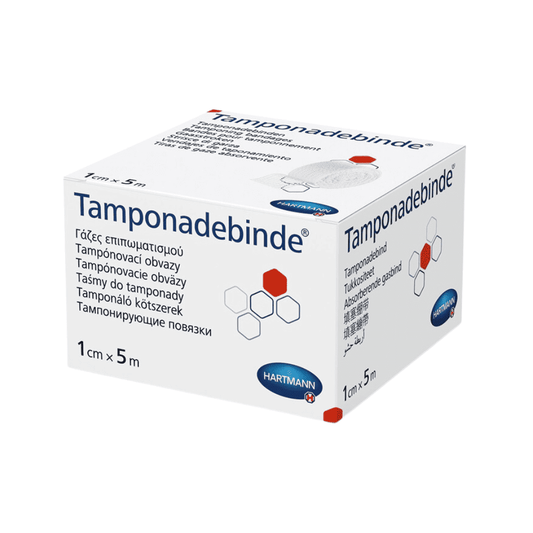
Hartmann Tamponadebinden made of cotton, different sizes
Regular price From ¥992 JPY From ¥992 JPYSale price From ¥992 JPY From ¥992 JPY Regular priceUnit price ¥198¥198 per m¥992 JPY ¥992 JPYDelivery
-

 Vendor:BSN Medical
Cutimed Sorbact, tamponade, antimicrobial wound dressing, sterile
Low stockRegular price From ¥67,550 JPY From ¥67,550 JPYSale price From ¥67,550 JPY From ¥67,550 JPY Regular priceUnit price ¥0 per¥67,550 JPY ¥67,550 JPYDelivery
-
 Sold outVendor:Meditrade
Cotton tampons with thread, Ø 5 cm | Pack (1 piece)
Regular price ¥5,925 JPY ¥5,925 JPYSale price ¥5,925 JPY ¥5,925 JPY Regular priceUnit price ¥0 per¥5,925 JPY ¥5,925 JPY





Tamponades for the Management of Wound Cavities and Body Cavities
Tamponades are used when a flat wound dressing is insufficient—for example, in cases of deep wounds, wound cavities, fistulas, or when treating natural body cavities. The tamponade is inserted into the cavity, fills it, and can absorb fluid there. Within wound care, tamponades thus constitute a distinct, specialized product group that is primarily used in hospitals, doctors’ offices, and professional healthcare settings.
Depending on the design, these come in the form of tamponade bandages, tamponade strips, or cotton swabs. The appropriate form depends on the type of cavity, its depth, and the physician’s instructions for the specific treatment.
Features and Benefits of Tamponades
What all tamponades have in common is that they are intended for insertion into a cavity and not merely for covering a wound surface. However, they differ significantly in material, format, and mechanism of action, resulting in different areas of focus within the collection.
Typical characteristics of tamponades include:
- Intended for insertion into wound cavities or body cavities
- absorbent material for absorbing fluid
- Available as bandages, strips, or tampons
- Sterile packaging, depending on the product
- varying widths, lengths, or diameters
- Selected products feature a bacteria-binding coating
Which of these characteristics apply in each individual case depends on the specific product. Whether a sterile version, a specific format, or a special mechanism of action is required depends on the wound condition and the guidelines provided by the treating healthcare professional.
Which tamponades are suitable for which applications?
Hartmann cotton tamponade bandages, available in various sizes, are intended for tamponading natural body cavities. According to the manufacturer’s specifications, they are made of pure cotton, have woven edges, are 5 m long, available in various widths, and are individually packaged in a sterile container.
For deep wounds, wound cavities, and wounds following the excision of fistulas and abscesses, the Cutimed Sorbact Tamponade—an antimicrobial wound dressing—is designed for use. The tamponade strip is coated with DACC, to which bacteria and fungi are physically bound, according to the manufacturer, and is therefore particularly suitable for infected or contaminated wounds.
When a single, smaller tampon is needed that can be easily removed, the cotton swabs with string (Ø 5 cm) are ideal. The attached string makes removal easier after use.
What should you look for when purchasing tamponades?
The most important criterion is the intended use: A tamponade for a natural body cavity has different requirements than a wound tamponade for a deep, potentially infected wound. For infected or contaminated wound cavities, a product with a bacteria-binding mechanism may be appropriate, while a cotton tamponade bandage is suitable for simple filling and absorption.
The size is equally important. The width and length of a pad or strip should match the size and depth of the cavity so that it can be filled without leaving an excessive amount of material behind. For tampons, the diameter is the decisive factor.
Additionally, one should verify whether the product is supplied sterile and whether the package size is appropriate for the intended use. As with all wound care products, the selection should be based on the manufacturer’s instructions and the physician’s orders, not on price or package size alone.
Bandage, strip, or tampon—how do tamponades differ?
Tamponade bandages are long, narrow strips that are inserted into a cavity in stages. Their length allows the amount inserted to be adjusted to the depth; woven edges can help reduce fraying.
Coated tampon strips combine filling the cavity with an additional mechanism of action. Unlike a plain cotton bandage, the focus here is on trapping germs, which are removed along with the strip during a change.
Cotton swabs have a compact, preformed size. They are less versatile than a pad, but can be inserted quickly and removed precisely using the string.
None of these forms is inherently better. The key consideration is whether to fill a cavity flexibly, utilize a germ-binding effect, or use a preformed tampon.
Use and Guidelines for Tamponades
The insertion and replacement of tamponades must be performed by medical professionals and carried out according to a doctor’s orders. Sterile tamponades should only be opened immediately before use and handled under aseptic conditions; if the packaging is damaged, the product should not be used as sterile.
When changing the tamponade, care must be taken to ensure that it is completely removed. Replacement intervals, possible combinations with other products, and contraindications are specified in the manufacturer’s instructions for the respective product.
Tamponades should be stored in a dry, clean place in accordance with the storage instructions on the packaging. Used tamponades are disposed of in accordance with the facility’s applicable hygiene and disposal guidelines.
Complementary Supplies for Tampon Care
Wound irrigation is used to clean a wound cavity before inserting a tamponade; compresses and wound dressings serve as secondary coverings over the tamponaded wound; and swabs assist in cleaning the area around the wound. The Wound Care category provides an overview of all other products for cleaning, disinfection, and coverage.


