
-

 Vendor:Paul Hartmann AG
Sterillium® hand disinfectant
Regular price From ¥408 JPYSale price From ¥408 JPY Regular priceUnit price ¥4,080 per l¥408 JPY -

 Vendor:Paul Hartmann AG
Bode Sterillium® Virugard Hand Disinfectant
Regular price From ¥459 JPYSale price From ¥459 JPY Regular priceUnit price ¥4,660 per l¥459 JPY -

 Vendor:Schülke & Mayr GmbH
Schülke Desderman® hand disinfection (without dye/perfume)
Regular price From ¥343 JPYSale price From ¥343 JPY Regular priceUnit price ¥3,430 per l¥343 JPY -

 Vendor:Paul Hartmann AG
Sterillium® Classic Pure Hand Sanitizer, Fragrance-Free
Regular price From ¥391 JPYSale price From ¥391 JPY Regular priceUnit price ¥3,910 per l¥391 JPY -

 Vendor:Dr. Schumacher GmbH
Dr. Schumacher Aseptoman® med hand disinfection
Regular price From ¥468 JPYSale price From ¥468 JPY Regular priceUnit price ¥3,120 per l¥468 JPY -
 Vendor:Altruan
Altruman® hand disinfectant - 500 ml | Bottle (500 ml)
Regular price ¥378 JPYSale price ¥378 JPY Regular priceUnit price ¥756 per l¥378 JPY -

 Vendor:Paul Hartmann AG
Hartmann Sterillium® Gel Hand Disinfection Gel
Regular price From ¥421 JPYSale price From ¥421 JPY Regular priceUnit price ¥2,042 per l¥421 JPY -

 Vendor:Paul Hartmann AG
Sterillium® med hand disinfectant
Regular price From ¥406 JPYSale price From ¥406 JPY Regular priceUnit price ¥4,060 per l¥406 JPY -

 Vendor:Meditrade GmbH
Meditrade Ethaseept® Hand Disinfectant
Regular price From ¥228 JPYSale price From ¥228 JPY Regular priceUnit price ¥2,280 per l¥228 JPY -

 Vendor:Schülke & Mayr GmbH
Schülke Desmanol® Care Handedesinfectant
Regular price From ¥362 JPYSale price From ¥362 JPY Regular priceUnit price ¥3,620 per l¥362 JPY -

 Sold outVendor:Dr. Schumacher GmbH
Dr. Schumacher Professional for you Surface Disinfection
Regular price From ¥268 JPYSale price From ¥268 JPY Regular priceUnit price per¥268 JPY -

 Vendor:Paul Hartmann AG
Hartmann sterillium® gel pure hands disinfection gel
Regular price From ¥400 JPYSale price From ¥400 JPY Regular priceUnit price ¥4,000 per l¥400 JPY -

 Vendor:Paul Hartmann AG
Hartmann Sterillium® Pure hand disinfection
Regular price From ¥430 JPYSale price From ¥430 JPY Regular priceUnit price ¥4,300 per l¥430 JPY -

 Vendor:Schülke & Mayr GmbH
Schülke Desderman® Care Gel for hygienic and surgical hand disinfection
Regular price From ¥463 JPYSale price From ¥463 JPY Regular priceUnit price ¥4,630 per l¥463 JPY -

 Vendor:Schülke & Mayr GmbH
Schülke Desmanol® Pure Hand Disinfectant
Regular price From ¥542 JPYSale price From ¥542 JPY Regular priceUnit price ¥5,420 per l¥542 JPY


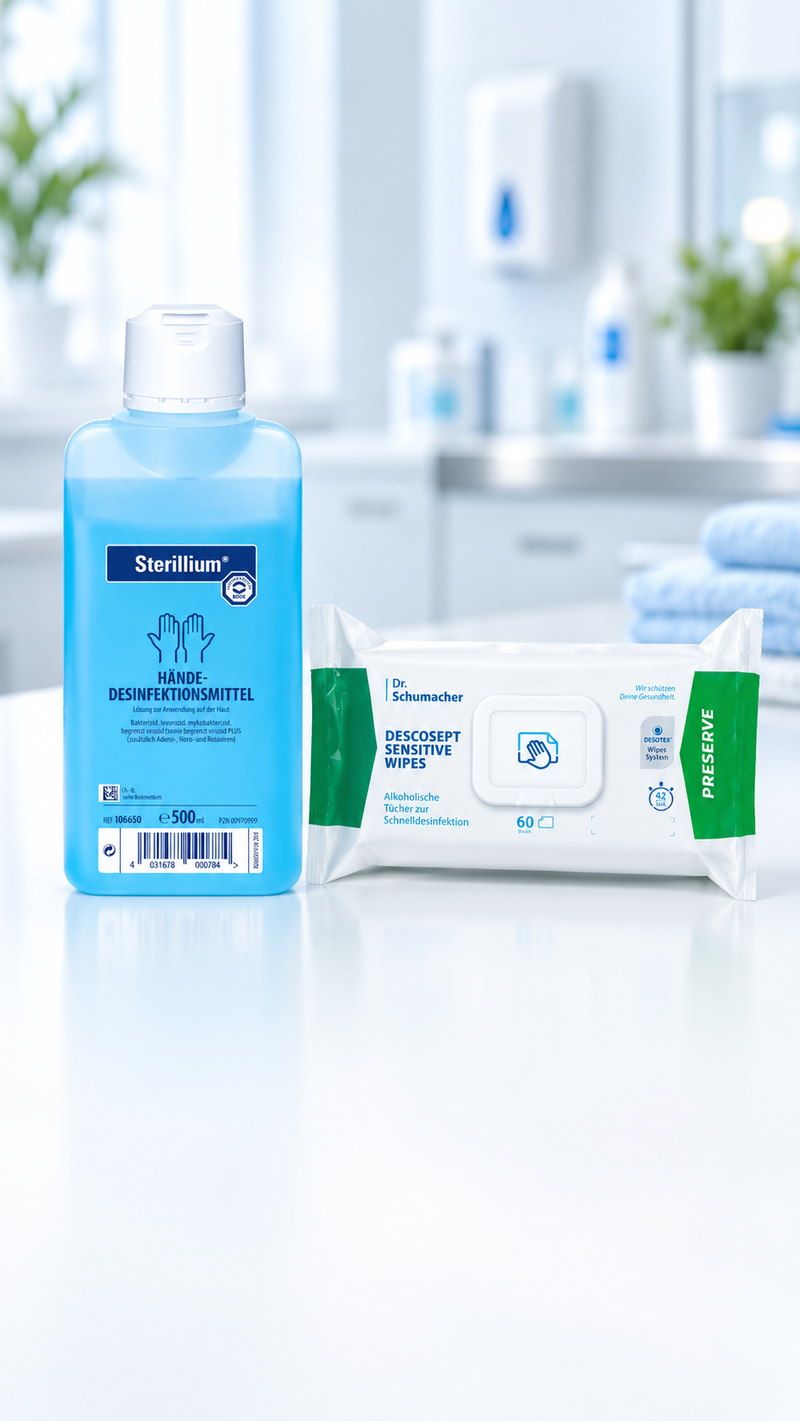


Hand Sanitization for Medical, Nursing, and Workplace Hygiene Settings
Hand sanitizers are designed to reduce the transmission of microorganisms via the hands in hygiene-sensitive work areas. Hand sanitizers are primarily used in doctors’ offices, hospitals, nursing facilities, laboratories, emergency medical services, and other settings with established hygiene protocols. They are typically applied ready-to-use to dry hands and are not rinsed off with water. Within the category of disinfectants, they thus constitute a distinct category dedicated to targeted hand hygiene.
Key factors in selecting a product include the intended area of application, the product’s formulation, and the expected consumption rate. For frequent use, a formulation free of certain fragrances or dyes may also be preferable. For workplaces with high consumption, it is also important to consider which container size can be effectively integrated into existing hygiene procedures.
Features and Benefits
Hand sanitizers are typically offered as ready-to-use liquids. This allows them to be made available directly at wash stations, treatment areas, nursing carts, entrances, or other designated hygiene stations. Depending on the work environment, the product is dispensed directly from the bottle or via a suitable dispenser system.
Differences exist, among other things, in composition, additives, and available container sizes. For example, there are versions without dyes or fragrances, as well as different packaging options for mobile use or situations with consistently higher demand. Which variant is suitable therefore depends not only on the product format but also on the intended hygiene procedure.
- Ready-to-use application
- Direct dispensing at hygiene stations
- Various container sizes
- Selection of various formulations
- Mobile or stationary use
- Controlled dispensing via suitable dispensers
- Integration into established hygiene procedures
These options make it easier to tailor hand hygiene to the actual needs of a facility. Both the frequency of use and the method of dispensing can be taken into account.
Which hand sanitizers are suitable for which applications?
For facilities seeking an established hand sanitizer for regularly used hygiene stations, Sterillium® Hand Sanitizer is a suitable option. It can be used, for example, in medical, nursing, or industrial settings, provided that the specific formulation is approved for the intended requirements.
Schülke desderman® Hand Sanitizer, free of dyes and fragrance, is particularly suitable for work areas where a specifically formulated version is intentionally required. The product name immediately identifies the dye- and fragrance-free variant, making it easier to select the product based on this characteristic.
Dr. Schumacher Aseptoman® med Hand Sanitizer offers another option for hand hygiene in professional settings. It may be suitable, for example, for medical or nursing facilities that wish to equip their hygiene stations with a hand sanitizer designed for the specific application.
What should you look for when purchasing hand sanitizer?
First, you should determine for which setting the product is needed. Requirements may vary between medical facilities, healthcare settings, and workplace hygiene stations. It is therefore crucial that the specified area of application and efficacy align with the respective operational guidelines. When selecting a disinfectant, you should specifically choose a formulation that is explicitly intended for hand hygiene.
For regular or very frequent use, the formulation also plays a role. Depending on the user group, for example, products without fragrance or dyes may be preferred. However, individual skin tolerance cannot be determined solely by the product type and should be taken into account accordingly when making a selection.
Container size and consumption should also be appropriate for the location of use. Small bottles may be suitable for mobile workstations or lower demand, while larger containers may be more practical for frequently used hygiene stations. When using existing dispenser systems, care should also be taken to ensure that the bottle and dispensing formats are compatible.
Small, medium, and large containers for different usage volumes
Smaller containers are particularly suitable for mobile applications, individual workstations, or areas with comparatively low usage. They are easy to transport and can be placed where no permanently installed dispenser is provided.
Medium-sized containers are ideal for regularly used hygiene stations. They combine a sufficient supply with a manageable size and, depending on the model, can be used directly or integrated into suitable dispenser systems.
Larger containers are particularly useful where hand sanitizer is frequently needed and consumption volumes are correspondingly higher. They can reduce the effort required for refilling or replacement but require a suitable storage location and a dispensing solution compatible with the specific packaging.
Application and Instructions for Hand Sanitization
Hand sanitizer is applied to the hands according to the intended use and carefully distributed. All relevant areas of the hands should be covered. The required amount and contact time depend on the specific product and the intended area of application.
To ensure reliable hygiene procedures, dispensing should be organized so that the product is easily accessible at the required locations. Dispensers and contact surfaces in the immediate vicinity should be included in the facility’s hygiene plan. At the same time, care must be taken to ensure that hand sanitizer is not unnecessarily mixed with other products or transferred to unsuitable containers.
Products should be stored in accordance with the manufacturer’s instructions and protected from unsuitable environmental conditions. Instructions on the label and in the product information regarding use, safety, shelf life, and disposal must be followed, particularly for chemical disinfectants. Empty containers and any remaining product that is no longer needed should be disposed of in accordance with the applicable workplace guidelines.
Complementary Products for Hand Hygiene
- Surface disinfection: complements hand hygiene by specifically disinfecting appropriate work surfaces and contact surfaces
- Disinfectant wipes: suitable for the on-the-go treatment of small surfaces and frequently touched objects
- Wound disinfection: covers a distinct area of application when products are needed for the antiseptic treatment of wounds
Together, these product groups can cover different areas of a coordinated hygiene concept. While hand sanitizer is directly focused on hand hygiene, other disinfectants complement the cleaning and disinfection of surfaces or other clearly defined areas of application.


