
-

 Vendor:Schülke & Mayr
Schülke Gigaseept® Instru AF instrument disinfection (aldehyde -free)
Unit price: ¥4,497¥4,497 / pieceRegular price From ¥8,993 JPY From ¥8,993 JPYSale price From ¥8,993 JPY From ¥8,993 JPY Regular priceUnit price ¥2,832¥2,832 per l¥8,993 JPY ¥8,993 JPYplus shipping
Delivery
-

 Vendor:Hartmann
Hartmann Bacillol® 30 sensitive green tissues quick disinfection towels | Package (120 towels)
Features: VAH-gelistet, IHO-gelistet
Unit price: ¥19¥19 / pieceRegular price ¥2,262 JPY ¥2,262 JPYSale price ¥2,262 JPY ¥2,262 JPY Regular priceUnit price ¥0 per¥2,262 JPY ¥2,262 JPYplus shipping
Delivery
-

 Vendor:Dr. Schumacher
Dr. Schumacher Perfektan® Active Instrument Dinfection
Unit price: ¥7¥7 / pieceRegular price From ¥279 JPY From ¥279 JPYSale price From ¥279 JPY From ¥279 JPY Regular priceUnit price ¥5,270¥5,270 per kg¥279 JPY ¥279 JPYplus shipping
Delivery
-
 Vendor:Schülke & Mayr
Schülke Rotasept® disinfection cleaner ready solution - 2 liters | Bottle (2 l)
Features: VAH-gelistet
Unit price: ¥1,769¥1,769 / pieceRegular price ¥3,537 JPY ¥3,537 JPYSale price ¥3,537 JPY ¥3,537 JPY Regular priceUnit price ¥1,769¥1,769 per l¥3,537 JPY ¥3,537 JPYplus shipping
Delivery
-

 Vendor:Dr. Schumacher
Dr. Schumacher Perfectan TB Instrument Dinfection
Features: VAH-gelistet
Regular price From ¥3,525 JPY From ¥3,525 JPYSale price From ¥3,525 JPY From ¥3,525 JPY Regular priceUnit price ¥3,525¥3,525 per l¥3,525 JPY ¥3,525 JPYplus shipping
Delivery
-

 Vendor:Dr. Schumacher
Dr. Schumacher DESCOTON FORTE
Features: RKI-gelistet
Regular price From ¥3,604 JPY From ¥3,604 JPYSale price From ¥3,604 JPY From ¥3,604 JPY Regular priceUnit price ¥3,604¥3,604 per l¥3,604 JPY ¥3,604 JPYplus shipping
Delivery
-
 Up to 6% offVendor:MaiMed
MaiMed MyClean IN, instrument disinfection
Regular price From ¥1,943 JPY From ¥1,943 JPYSale price From ¥1,943 JPY From ¥1,943 JPY Regular priceUnit price ¥1,372¥1,372 per l¥1,943 JPY ¥1,943 JPYplus shipping
Delivery
-

 Vendor:Hartmann
Hartmann Bodedex® Forte instrument cleaner
Unit price: ¥2,011¥2,011 / pieceRegular price From ¥4,022 JPY From ¥4,022 JPYSale price From ¥4,022 JPY From ¥4,022 JPY Regular priceUnit price ¥2,011¥2,011 per l¥4,022 JPY ¥4,022 JPYplus shipping
Delivery
-

 Vendor:Dr. Schumacher
Dr. Schumacher DESCO DRILL BATH
Unit price: ¥1,257¥1,257 / pieceRegular price From ¥2,514 JPY From ¥2,514 JPYSale price From ¥2,514 JPY From ¥2,514 JPY Regular priceUnit price ¥1,257¥1,257 per l¥2,514 JPY ¥2,514 JPYplus shipping
Delivery
-

 Vendor:Dr. Schumacher
Dr. Schumacher DESCOTON EXTRA Disinfectant
Features: VAH-gelistet
Regular price From ¥3,029 JPY From ¥3,029 JPYSale price From ¥3,029 JPY From ¥3,029 JPY Regular priceUnit price ¥3,029¥3,029 per l¥3,029 JPY ¥3,029 JPYplus shipping
Delivery
-
 Vendor:Meditrade
Meditrade Instrusol® AF+ instrument disinfection 2 liters | Bottle (2 l)
Features: VAH-gelistet
Unit price: ¥1,983¥1,983 / pieceRegular price ¥3,966 JPY ¥3,966 JPYSale price ¥3,966 JPY ¥3,966 JPY Regular priceUnit price ¥1,983¥1,983 per l¥3,966 JPY ¥3,966 JPYplus shipping
Delivery
-

 Vendor:Dr. Schumacher
Dr. Schumacher PERFEKTAN® NEW
Features: VAH-gelistet
Regular price From ¥4,508 JPY From ¥4,508 JPYSale price From ¥4,508 JPY From ¥4,508 JPY Regular priceUnit price ¥4,508¥4,508 per l¥4,508 JPY ¥4,508 JPYplus shipping
Delivery
-
 Vendor:Schülke & Mayr
Schülke Gigazyme®, enzyme cleaner - 2 liters | Bottle (2 l)
Unit price: ¥4,184¥4,184 / pieceRegular price ¥8,368 JPY ¥8,368 JPYSale price ¥8,368 JPY ¥8,368 JPY Regular priceUnit price ¥4,184¥4,184 per l¥8,368 JPY ¥8,368 JPYplus shipping
Delivery
-
 Vendor:Meditrade
Instrusol® AF+, instrument disinfection, 500 ml | Bottle (500ml)
Unit price: ¥2¥2 / pieceRegular price ¥1,192 JPY ¥1,192 JPYSale price ¥1,192 JPY ¥1,192 JPY Regular priceUnit price ¥2,384¥2,384 per l¥1,192 JPY ¥1,192 JPYplus shipping
Delivery
-
 Vendor:MaiMed
MaiMed MyClean B drill bath 5l/can, 1 piece | Canister (5 l)
Low stockUnit price: ¥701¥701 / pieceRegular price ¥3,507 JPY ¥3,507 JPYSale price ¥3,507 JPY ¥3,507 JPY Regular priceUnit price ¥701¥701 per l¥3,507 JPY ¥3,507 JPYplus shipping
Delivery


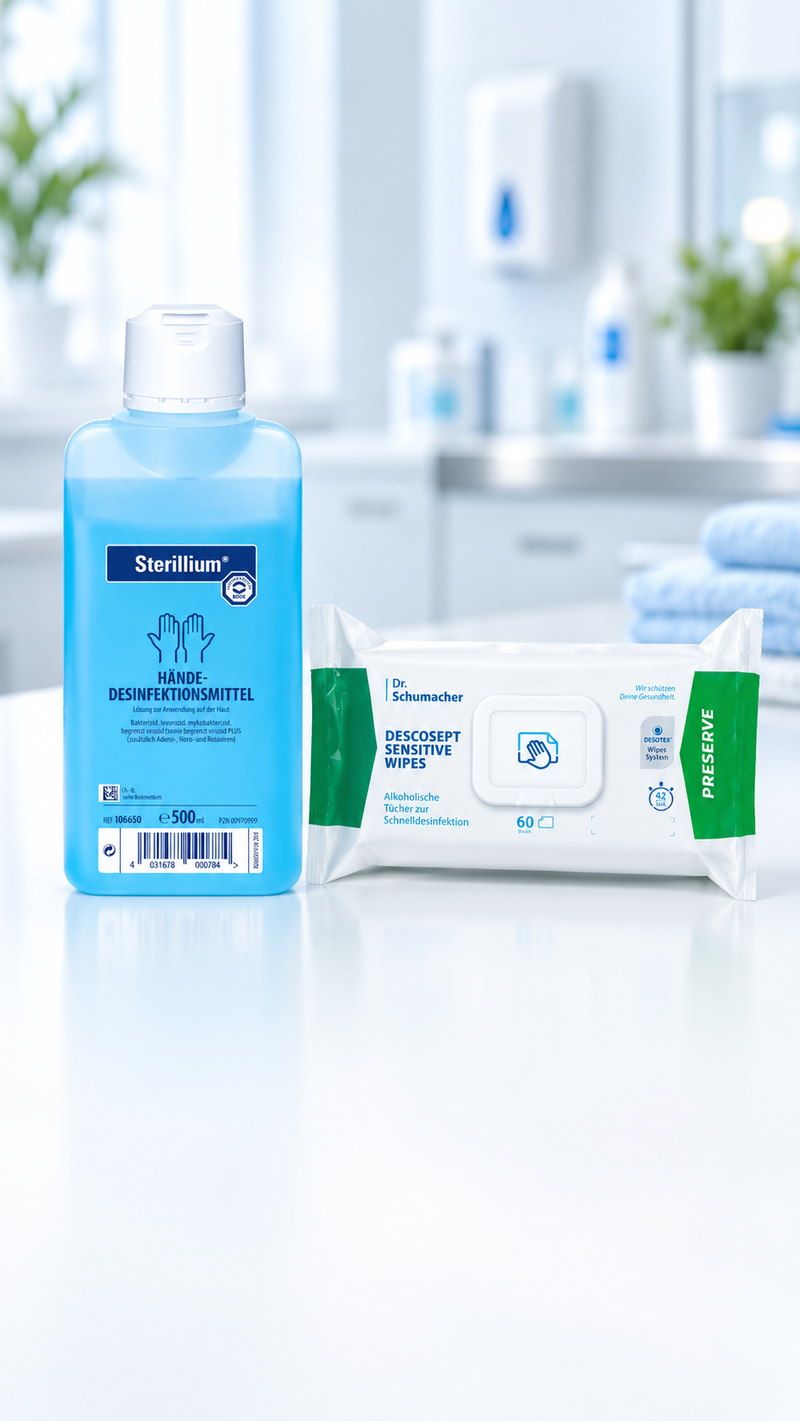


Instrument Disinfection for Medical, Nursing, and Hygiene Settings
Instrument disinfection is used for the hygienic reprocessing of suitable medical instruments and equipment. Instrument disinfection products are used primarily in doctors’ offices, hospitals, nursing facilities, laboratories, and other settings where reusable instruments must be treated according to established hygiene protocols. Within the category of disinfectants, they represent a specific application area focused on the reprocessing of instruments.
When selecting a product, the type of instruments to be reprocessed, the intended application method, and the requirements of the respective work area are the most important factors. Additionally, the composition of the disinfectant and the required amount used may play a role. The selection should therefore always be tailored to the actual reprocessing process.
Properties and Benefits of Instrument Disinfection
Products for instrument disinfection are developed for the targeted hygienic treatment of suitable instruments. Depending on the product type, they can be used, for example, as part of manual reprocessing procedures. Products differ, among other things, in terms of their formulation and intended use, meaning that not every agent is automatically suitable for every instrument or workflow.
Further differences may arise from the active ingredient base, the required dosage, or the available container sizes. Special formulations, such as aldehyde-free variants, may also be of interest for specific requirements. It is crucial that the procedure used is appropriate for the instrument, its materials, and the intended hygiene process.
- Targeted reprocessing of suitable instruments
- Various formulations available
- Selection based on specific application
- Various package sizes
- Integration into established hygiene procedures
- Suitable for professional reprocessing areas
- Various application concepts available
These options allow instrument reprocessing to be adapted to different work environments and processes. This helps support structured and repeatable workflows, particularly in areas with a high volume of instruments.
Which instrument disinfection products are suitable for which applications?
For work areas where aldehyde-free instrument disinfection is required, Schülke gigasept® instru AF Instrument Disinfection is a suitable option. The product name itself indicates its aldehyde-free formulation. This makes the product particularly appealing to facilities that specifically want to consider this aspect when selecting their disinfectant.
Dr. Schumacher Perfektan® Active Instrument Disinfectant is intended for professional reprocessing areas where medical instruments are regularly sanitized. The product may be suitable, for example, in medical practices, healthcare facilities, or other work areas with established reprocessing procedures.
In contrast, the Hartmann Bacillol® 30 Sensitive Green Tissues rapid disinfection wipes shown in the image are, according to their product name, disinfection wipes and not a traditional instrument disinfectant. They may be suitable for use on appropriate surfaces or objects as part of a broader hygiene plan, but should be distinguished from specialized instrument disinfectants in terms of their specific scope of application.
What should you look for when purchasing instrument disinfectants?
First and foremost, it is crucial to determine which instruments are to be reprocessed and what requirements apply to the respective work area. Different types of instruments and reprocessing procedures may require different methods. Therefore, a product should be selected whose specified scope of application matches the intended use. When it comes to disinfectants, a clear distinction between instrument, surface, and other disinfection products is particularly important.
Another selection criterion is the product’s composition. Certain facilities, for example, prefer aldehyde-free formulations. At the same time, it is important to consider the materials from which the instruments to be treated are made and whether the intended product is suitable for them. This helps prevent a product from being selected solely based on its general designation, even though it may not be compatible with the existing instruments.
For regular use, container size and dosage also play a role. Smaller packages may be practical for work areas with lower demand, while larger containers can be integrated more cost-effectively into the workflow for frequently recurring instrument reprocessing. For concentrates, it is also important to consider how the required working solution can be prepared safely and consistently in the respective facility.
Ready-to-use products and concentrates for different workflows
Ready-to-use disinfectants can be useful where direct application is required without first preparing a solution. They reduce preparatory steps and are particularly suitable for clearly defined applications where an immediately available solution is needed.
Concentrates, on the other hand, are diluted with water according to the specified dosage to create the working solution before use. They can be particularly advantageous for regular or higher usage, as a single container can yield a larger volume of working solution. To achieve this, dosing and preparation must be reliably integrated into the workflow.
Which form is more suitable therefore depends less on a general quality assessment than on the existing processes. Facilities with frequent reprocessing cycles may have different requirements than smaller practices with a lower volume of instruments. The key factor is that the chosen form of application can be reliably implemented within the organizational structure.
Application and Instructions for Instrument Disinfection
Before disinfection, instruments should be prepared in accordance with the intended reprocessing procedure. When using manual methods, care must be taken to ensure that the disinfectant or the prepared working solution adequately reaches the areas to be treated. Dosage and contact time must be tailored to the product used and the specific process.
To ensure a hygienically controlled process, used and already reprocessed instruments should be clearly separated from one another. Disinfection containers and other equipment used must be integrated into the facility’s hygiene process so that the individual steps can be carried out in a traceable manner. Depending on the instrument, further reprocessing steps may be required after disinfection.
Storage, preparation, and disposal depend on the specific type of product. Concentrates and ready-to-use solutions should be stored in a protected manner and in the containers intended for that purpose. For chemical disinfectants, the manufacturer’s instructions regarding dosage, contact time, material compatibility, safety, and disposal must be strictly followed.
Suitable Add-Ons for Instrument Reprocessing
- Surface disinfection: complements instrument reprocessing by providing hygienic treatment of suitable work surfaces, storage surfaces, and contact surfaces
- Disinfectant wipes: suitable for the targeted disinfection of appropriate smaller surfaces and frequently touched objects
- Disinfectant dispensers: enable the controlled provision of appropriate disinfectant products at designated hygiene stations
Together, these categories can cover various tasks within professional hygiene protocols. While instrument disinfection focuses on the reprocessing of appropriate instruments, additional disinfectants and suitable dispenser systems complement the hygienic organization of work surfaces and other relevant areas.


